
An AI-assisted DevOps workflow built around private agents, clear ownership, and controlled delivery for a lean SaaS team.
1. AI-Assisted DevOps Changes the Team's Work
AI-assisted DevOps changes how a small SaaS team turns requirements into working software. A model can draft an implementation, explore unfamiliar code, generate tests, and investigate failures. A private Agent can execute those tasks inside a managed workspace. Together, they can reduce the effort needed to move from an idea to a reviewable change.
For a small SaaS provider, this matters across the product lifecycle. The same engineers often build features, support customers, maintain infrastructure, and respond to incidents. Time saved on repetitive work can create room for product improvements and maintenance that would otherwise keep slipping.
However, the workflow must change with the capability. If producing a patch becomes easier, review, integration, and operational validation can become the next constraints. A team that accepts more changes than it can evaluate may simply move its backlog downstream.
The question I want to explore is how a lean SaaS team should organize that work. Where should AI act independently? What evidence should a change carry? Which decisions still require a person? Architecture and workflow connect those answers to permissions that the system can enforce.
2. The AI-Assisted DevOps Workflow: From Tasks to Evidence
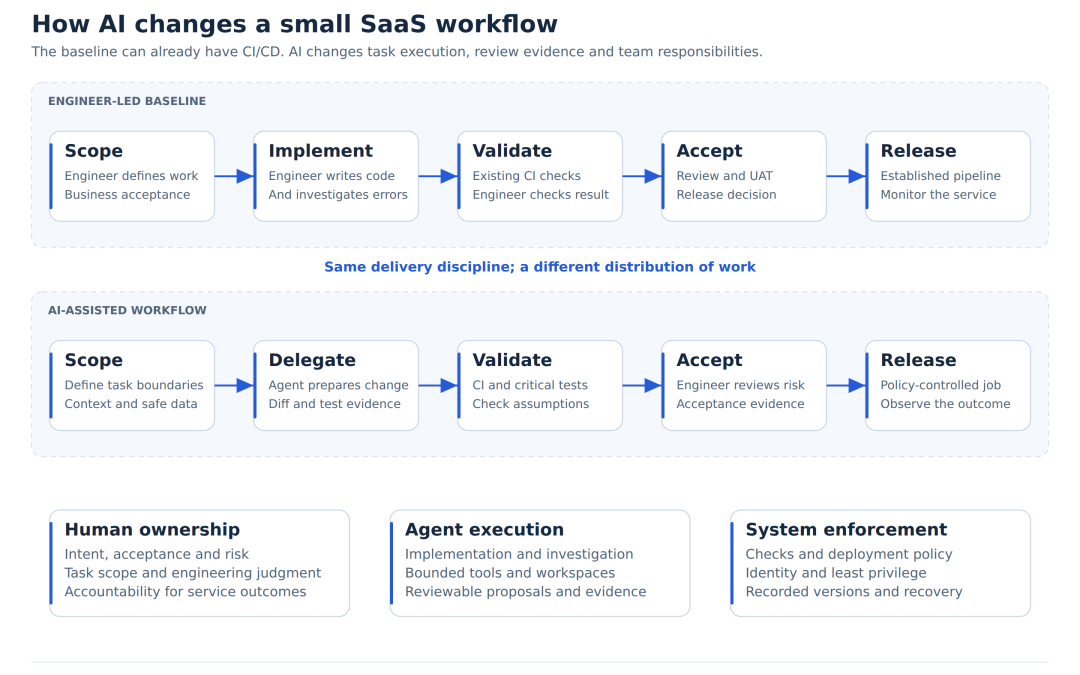
Many teams already have CI/CD. AI adds an execution partner upstream of those pipelines: it can inspect a repository, propose several approaches, implement a bounded task, and respond to test failures. That changes how engineers spend their time, even when the underlying release mechanism stays the same.
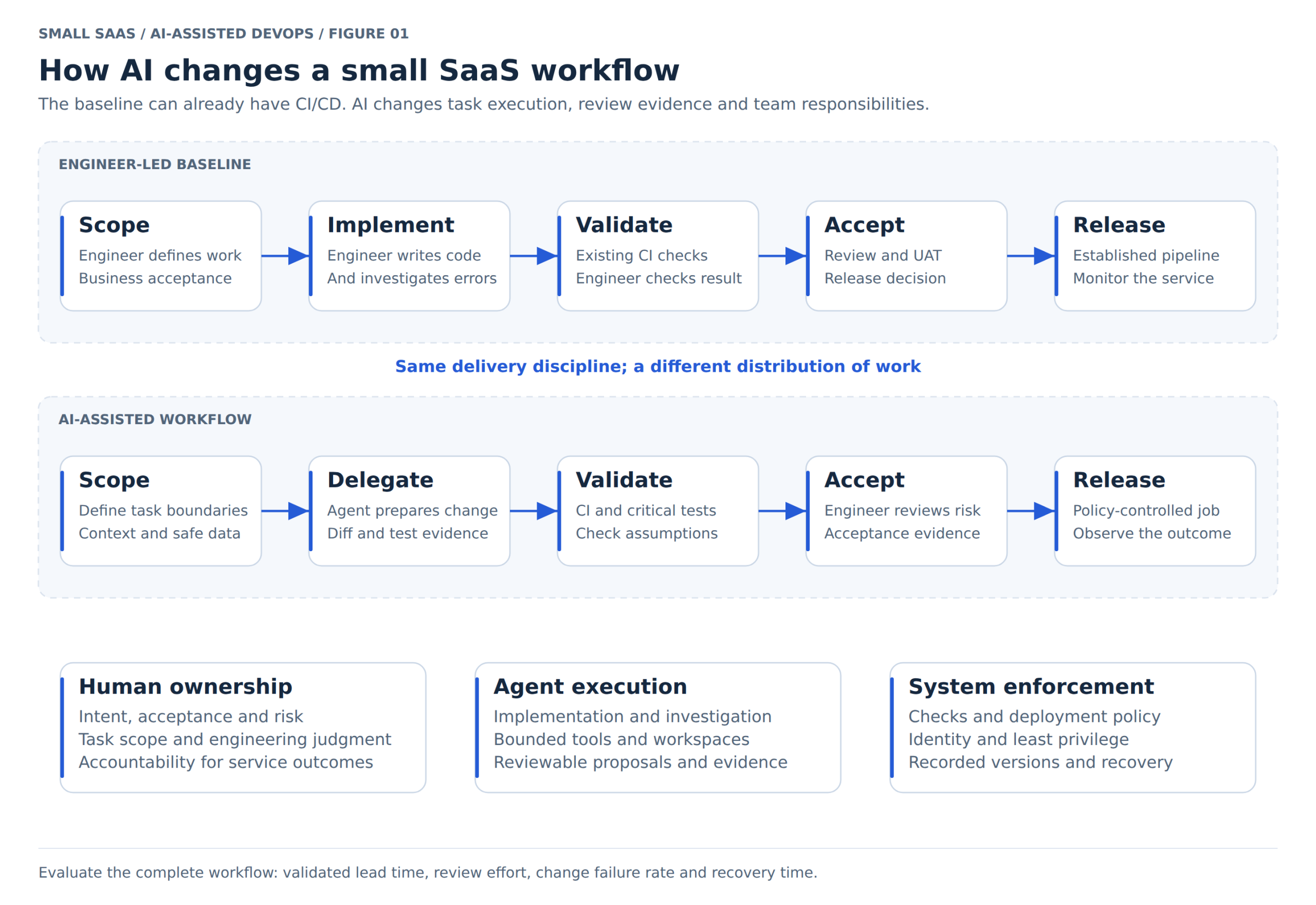
Figure 1. CI/CD remains part of both workflows. The main shift is in task execution and the evidence engineers use to evaluate a change.
An engineer's work increasingly includes defining the task, supplying context, evaluating alternatives, and checking the result. The Agent handles a portion of implementation and investigation. Tests and release controls continue to enforce repeatable rules.
A useful task therefore needs more than a feature description. It needs an acceptance boundary: the behavior to change, the behavior to preserve, the data it may use, and the checks that will demonstrate success. For example, a tenant-filtering change should include a test that rejects access to another tenant's records. A successful response for the intended user is only half the requirement.
The handoff should also change. A completed Agent task should provide a diff, relevant test results, assumptions, and unresolved risks. A confident explanation is useful context, but the team should be able to inspect the evidence independently.
This makes work smaller and easier to review. Instead of asking an Agent to redesign a feature and its infrastructure in one step, the team can separate the interface contract, application change, and deployment adjustment. Each change then has a clearer owner and a more limited failure impact.
3. Architecture: Separate Reasoning, Execution, and Release Authority
AI-assisted DevOps benefits from an architecture that distinguishes the model, the private Agent, the repository, the deployment runner, and the running application. These components can use familiar tools; their permissions and relationships are the important design choices.
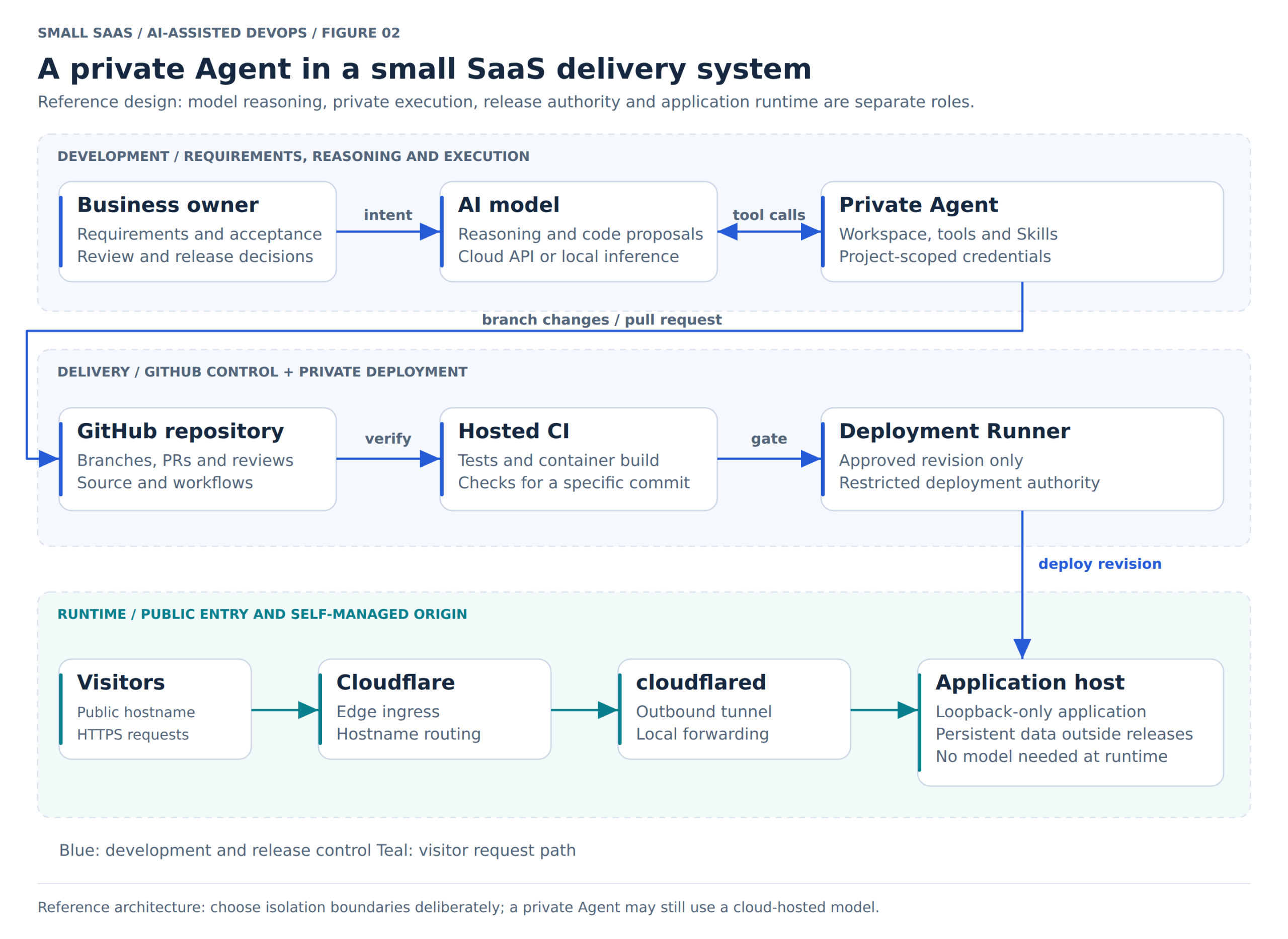
Figure 2. A reference architecture for a small SaaS team. Development and deployment use a controlled path; customer traffic follows a separate runtime path.
The model reasons about the task. The private Agent works in a managed environment with project-scoped repository access and approved tools. GitHub records proposed changes, reviews, and checks. A deployment runner receives the authority required to release an approved version. The application serves customers independently of the development Agent.
For the reference design here, GitHub Actions coordinates validation and deployment to a self-managed server. Cloudflare Tunnel provides the public application path. Its server-side connector initiates outbound connections, allowing the origin service to remain on a local or private address. Cloudflare documents this connection model. Application authentication and authorization still require their own controls.
This division gives the team concrete boundaries. A development Agent does not need unrestricted access to the production host. A deployment runner does not need every customer's data. Customer requests do not need to pass through the model used for development.
A private Agent may still call a cloud-hosted model. As a result, execution location and data handling need separate decisions. Repository context, support material, and tool output should follow an explicit sharing policy. Credentials should stay in controlled storage, and tenant data should be removed or replaced before entering model context whenever possible.
4. Put Repeatable Context Around the Agent
A small team loses time when every task begins with the same environmental questions. Which test command is authoritative? How does staging differ from production? Which directories contain live data? Where is the recovery procedure?
Versioned project instructions, Skills, and runbooks can answer those questions consistently. They help a new conversation or a different engineer start from the same operating knowledge. Because these instructions guide execution, the team should maintain them alongside the code and update them when the system changes.
In this AI-assisted DevOps workflow, each task starts with a scoped workspace, the relevant design decisions, safe test data, and the permitted tool set. The Agent can run local checks and prepare a pull request without inheriting broad infrastructure credentials. Task history should also connect to the issue and commit so another engineer can continue the work.
Shared context also needs maintenance. An outdated runbook can make an Agent repeat an obsolete procedure very efficiently. Therefore, context quality belongs in engineering ownership: review important instruction changes, identify authoritative sources, and retire conflicting guidance.
External material needs a different treatment. An issue, web page, dependency message, or application log can contain text that attempts to redirect the model. OWASP describes this as indirect prompt injection. The Agent's tool permissions must limit the consequences, even if the model follows a malicious instruction. A written rule alone cannot enforce that boundary.
5. Preserve Independent Validation and Controlled Delivery
A model can write both code and tests that share the same mistaken assumption. Consequently, passing generated tests is useful evidence, but it does not independently establish that a requirement was correct.
Engineers still own acceptance criteria and critical test cases. For a SaaS system, these include tenant separation, permission boundaries, billing behavior, data retention, and compatibility with existing clients. CI should also run the project's established regression checks against safe, isolated fixtures.
The delivery path can remain compact: feature branch, automated checks, review, staging validation, authorized release, and post-release observation. A change must carry its commit identity and test results through that path. Where containers are used, promoting the tested image digest avoids rebuilding a different artifact for production.
Make Deployment Authority Specific
Successful validation should be an explicit dependency of the deployment job. Two workflows triggered by the same push do not create that dependency. Production credentials should become available only within the intended release path, using the repository and environment protections available to the organization.
Runner isolation matters as well. GitHub warns that untrusted workflow code can compromise a self-hosted runner and access its resources. Approval settings do not turn a persistent runner into a clean isolation boundary. GitHub's secure-use guidance is particularly relevant when public contributions and private deployment infrastructure coexist.
A small team can use hosted environments for untrusted checks and a narrowly scoped deployment environment for releases. It should also separate code artifacts from persistent business data and maintain a verified recovery procedure. However, restoring a previous application version cannot automatically reverse a destructive database migration.
This extends my earlier discussion of SIT, UAT, and release strategy. Technical validation, business acceptance, and production authorization answer different questions, even when a small team combines some environments.
6. Match Autonomy to the Consequences of a Mistake
Requiring a person to confirm every tool call would waste much of the benefit. Granting the Agent permanent administrator access creates a different problem: a task-level mistake can become a production incident.
A better AI-assisted DevOps policy assigns autonomy according to scope, reversibility, and the ability to verify an outcome. The following examples describe a starting policy; each business must adapt it to its service and data.
| Work category | Useful Agent autonomy | Enforced boundary |
|---|---|---|
| Investigation | Read approved metrics, redacted logs, and repository context | Read-only access, limited scope, controlled data sharing |
| Bounded implementation | Edit a feature branch, run tests, and open a PR | Isolated workspace, safe fixtures, no production credentials |
| Routine release | Invoke an established pipeline when its release policy allows | Required checks, approved revision, restricted deployment identity |
| High-impact change | Prepare a migration, access-policy change, or recovery plan | Named authorization, reviewed procedure, recovery prerequisites |
The human decision should apply to a concrete action and its evidence. A database change needs the target environment, affected scope, migration plan, and recovery limits. A vague request to “make the system healthy” gives neither the engineer nor the Agent a reliable boundary.
For frequent, reversible work, the team can approve the operating rule in advance. For example, restarting a specific unhealthy service may follow an established runbook with rate limits and escalation. Changes to tenant permissions, destructive data operations, or the release policy itself deserve stronger review.
This continues the principle of restricted runners and minimal authorization. The operating system, repository policy, and tool interface should enforce the granted authority. The model does not grant itself more access when it encounters a difficult task.
7. Close the Loop Between Delivery and Operations
The workflow continues after deployment. Monitoring can provide the Agent with scoped evidence to correlate a symptom with a recent change, summarize likely causes, and prepare a repair. An engineer can then evaluate the proposal with the same checks used for feature work.
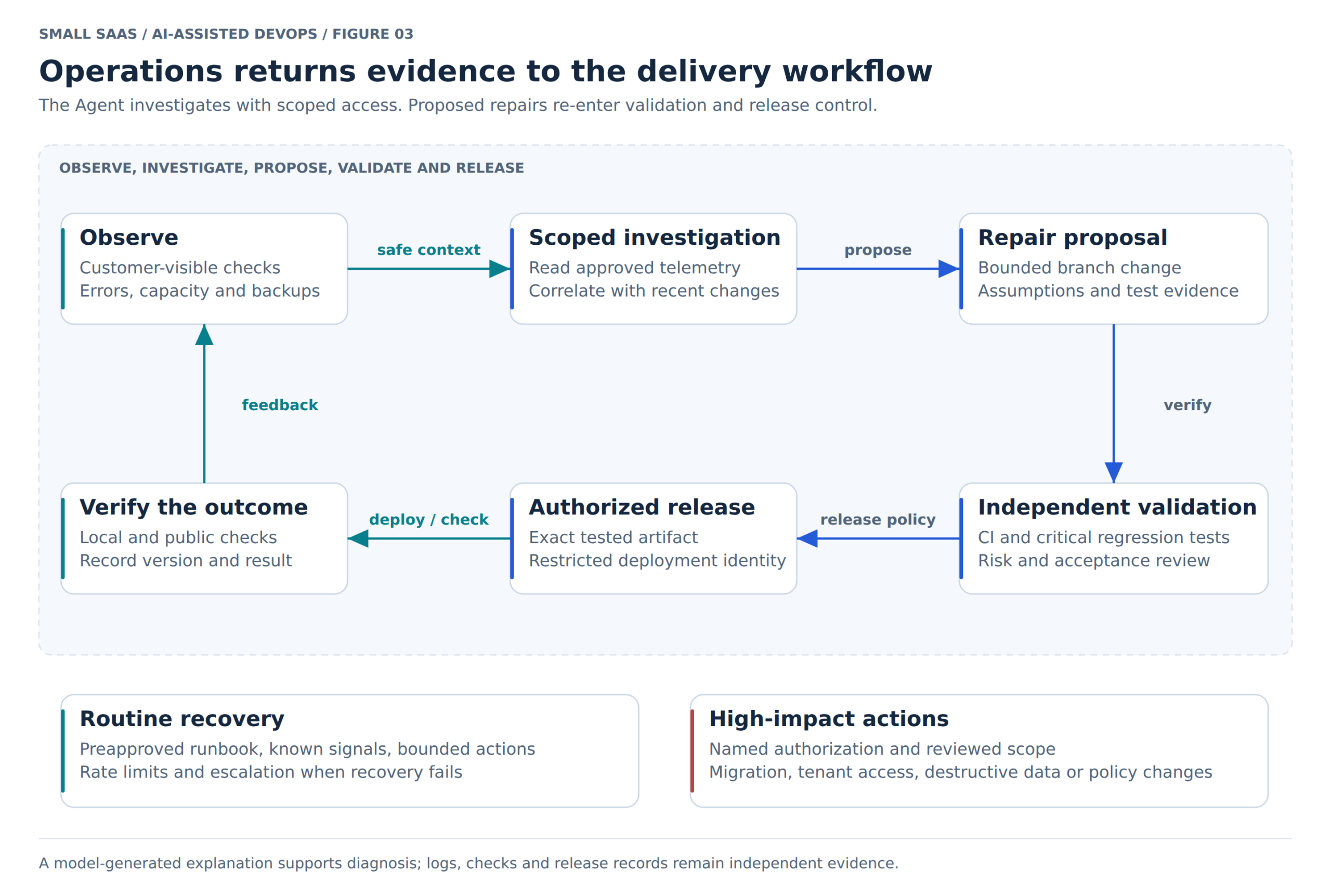
Figure 3. AI-assisted investigation returns proposed repairs to the established delivery path. Preapproved recovery actions remain bounded by their runbooks.
The operational record should connect the incident, code revision, artifact, deployment job, and acting identity. An Agent explanation can help engineers navigate that record. However, the service's health signals and deployment logs must remain available independently of the conversation.
Monitoring should cover customer-visible behavior as well as infrastructure. For example, a healthy process can still return authorization errors or fail a tenant-specific workflow. Public availability, application errors, latency, capacity, and backup completion provide different parts of the picture.
A failed public check also needs diagnosis. An application rollback may help with a bad release, but it cannot repair every DNS, tunnel, or external dependency failure. Recovery automation should use known signals and limited actions, then escalate when those actions do not restore service.
Data recovery belongs in this loop too. Backups need restore testing, separate failure locations, and clear retention rules. For a SaaS business, the team must understand how a restore affects customer records and previously deleted data. Generating a backup script is only the beginning of that operational responsibility.
8. Adopt AI-Assisted DevOps in Measurable Steps
A practical adoption path starts with work that is easy to inspect: repository exploration, test preparation, documentation, and bounded fixes. Once context and validation are reliable, the team can expand to larger implementation tasks and routine operational investigation. Production autonomy should grow with demonstrated controls and recovery capability.
Measure the whole workflow. Useful indicators include lead time to a validated release, engineer review time, rework, change failure rate, and time to recover. Agent usage and infrastructure costs belong in that assessment as well. More generated code or more pull requests do not by themselves show that customers receive better software.
For example, if implementation becomes faster but review queues grow, the next improvement may be smaller tasks or better test evidence. Adding more autonomous work would increase the queue. Likewise, recurring environment failures call for a reproducible workspace before broader automation.
ScaleTag is a small personal experiment that helped me examine this operating model. It provides a place to test assumptions, rather than proof that a production SaaS team has achieved every control described here.
The broader goal is a workflow a small team can sustain: AI helps execute well-scoped work, engineers own intent and acceptance, and the delivery system enforces release authority. Architecture makes these responsibilities concrete. When those pieces fit together, AI capability can support faster iteration while the team retains the ability to explain, verify, and recover its changes.