

1. The State of Modern SysOps: Efficiency vs. Security Debt
Small-to-mid-sized SaaS providers often use Ansible to manage infrastructure quickly, but speed frequently comes at the cost of security. While automation drives agility, many teams use a “workstation-to-production” model that risks the entire environment. This article explores how to harden these pipelines using Minimalist Engineering and architectural isolation to build a resilient, zero-footprint deployment process.
In a typical startup, the workflow is dangerously simple: a DevOps engineer runs Ansible commands directly from a local laptop to update production servers. This direct connection is undeniably fast, allowing small teams to act like much larger ones. However, this simplicity creates a fragile environment where highly privileged SSH keys sit on personal devices with no restricted boundaries. If a hacker compromises a single laptop, they gain immediate control over the production fleet.
As architects, our goal is not to build a “perfect” system, but to design one that tolerates failure. A stolen key should be a localized incident, not a total catastrophe. By shifting toward an architecture that absorbs shocks through strict isolation and granular permission control, we can limit the “blast radius” of any single failure. This approach ensures that automation remains a powerful asset without becoming a fatal liability for the business.
2. The Double-Edged Sword: Analyzing Common Attack Vectors
Ansible offers simplicity, but that simplicity often hides a massive attack surface. Because it is an agentless tool, it relies on a “Push” model that requires high-level access to every target in the fleet. For many SaaS teams, this powerful connectivity is exactly what makes the infrastructure vulnerable.
The “Blast Radius” of Local Workstations
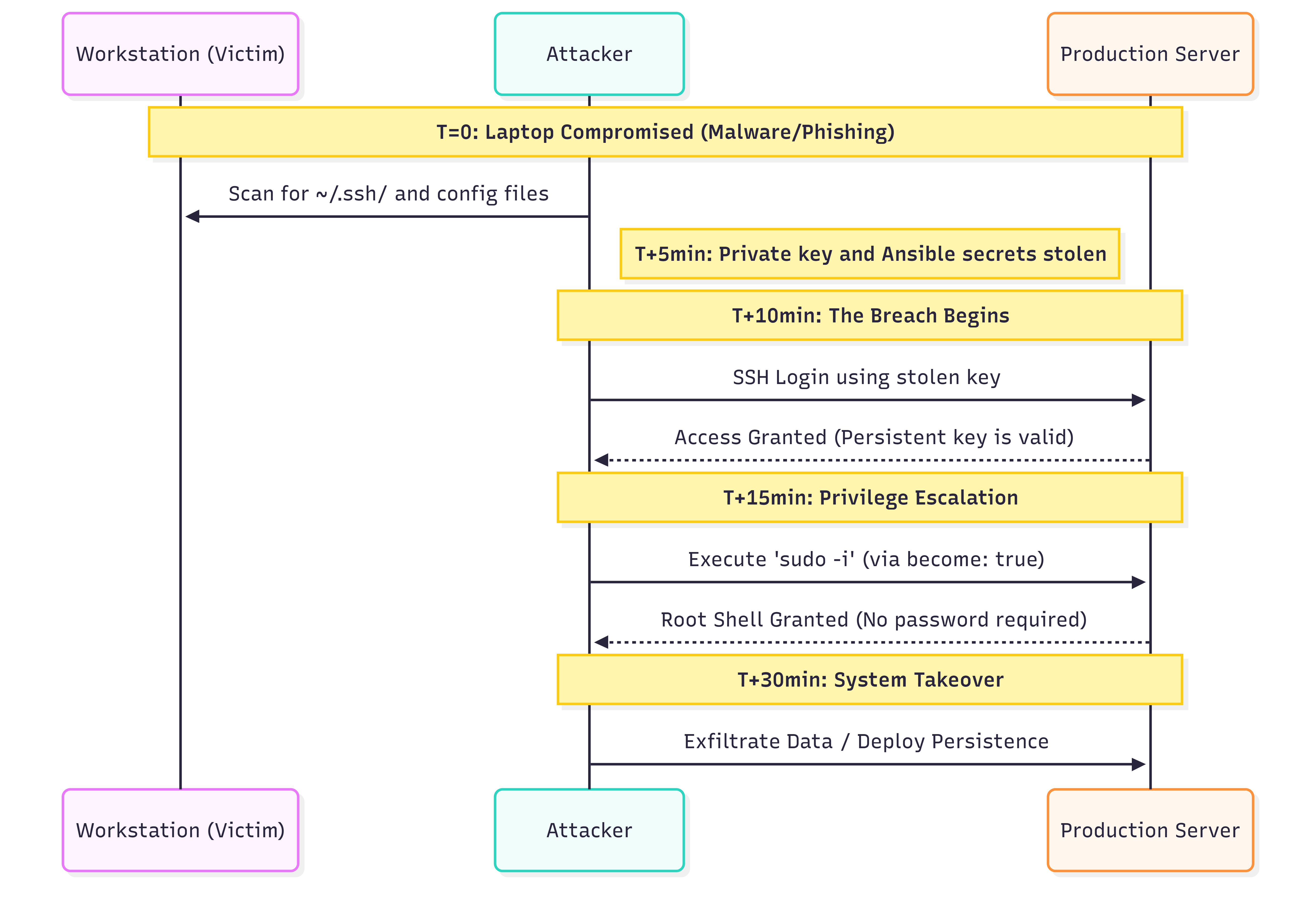
In many startups, the engineer’s laptop is the “control plane.” If an attacker gains access to this workstation, they don’t just get one person’s emails—they inherit the ability to run Ansible. Since many local setups lack strict session management, a compromised laptop provides a persistent, direct tunnel into every production server. The “blast radius” is no longer limited to a single device; it encompasses the entire SaaS backend.
The Danger of Persistent, Over-Privileged Credentials
The most common mistake is using “always-on” SSH keys. When a private key stays on a disk for months without rotation, it becomes a ticking time bomb. This is often combined with the become: true habit—giving Ansible the power to run every command as root. Without granular control, a single leaked key gives an attacker “God mode” access, allowing them to bypass security logs, exfiltrate databases, or install silent backdoors across the entire network.
The Lack of Execution Traceability
When Ansible runs directly from a workstation, audit trails are often fragmented or non-existent. Traditional logs might show that a user logged in, but they rarely capture the full context of the automation script that was executed. This lack of transparency means that if a malicious change is pushed, it is difficult to detect exactly when it happened or what was modified. In a professional architecture, we cannot afford this “black box” execution; we need every action to be isolated, logged, and verifiable.
3. The Minimalist Architecture: Finding Equilibrium
In DevOps, security and convenience sit on opposite sides of a scale. For a small SaaS team, leaning too far toward “Security” can paralyze development, while leaning toward “Convenience” creates a fragile system. However, for small-to-mid-sized providers, I recommend a stronger tilt toward security. Unlike giant corporations, a smaller SaaS business cannot survive the devastating blow of a full production breach. The architecture must evolve to tolerate failure by building “speed bumps” that prevent a single leak from becoming a total collapse.

Moving from Workstations to Pipeline-Driven Execution
The first step is to remove the local workstation from the trust loop. By using GitHub Self-Hosted Runners triggered via GitHub Pipelines, we eliminate the need for direct connections from personal laptops. Teams should manage all keys and passwords exclusively through GitHub Secrets. In this model, the pipeline injects sensitive credentials at runtime, and they disappear the moment the job finishes.
Isolation through Containerized Execution
Even within the runner, we must ensure isolation. Running Ansible inside a temporary container ensures that each deployment task happens in a clean, “zero-footprint” environment. This prevents credential leakage in the host’s memory or log files. If an attacker compromises a container, the transient file system traps them before the system destroys itself in minutes.
Granular Command Auditing via sudoers.d
On the target production servers, we must move away from the dangerous habit of global become: true. Instead, use sudoers.d to strictly whitelist only the specific commands Ansible is allowed to run. While some teams use the wildcard * to save time, I strongly advocate for strict command auditing. By limiting the Ansible user to specific binaries, you ensure that even if a credential is stolen, the “blast radius” is confined. The attacker might be able to restart a service, but they cannot exfiltrate the database or wipe the system.
4. Conclusion: Engineering for Resilience
Building a secure infrastructure for a growing SaaS provider is not about achieving absolute perfection, but about designing for survival. By shifting from local workstation execution to a pipeline-driven, containerized architecture, you replace a fragile “all-or-nothing” security model with a resilient system that can absorb shocks. Professional DevOps engineering is defined by this ability to balance speed with a “zero-footprint” philosophy, ensuring that your automation tools remain a competitive asset rather than a catastrophic liability.
In the final analysis, the move toward Minimalist Engineering is a strategic investment in the longevity of the business. For small-to-mid-sized providers who lack the massive security departments of tech giants, the architecture itself must serve as the primary defense. When you implement restricted runners, ephemeral execution environments, and granular command auditing through sudoers.d, you are effectively shrinking the blast radius of any potential compromise. This approach acknowledges that while failures—like a leaked key or a compromised laptop—are never desired, they must be survivable. Embedding these “speed bumps” into your deployment process ensures the core production environment stays isolated and operational during an attack. This is the hallmark of a mature DevOps culture: creating an infrastructure that is powerful enough to drive innovation, yet resilient enough to tolerate the inevitable failures of the real world.